
Velocity Meets Art: Ranking the Fastest Pagani Supercars of All Time
In the rarefied atmosphere of hypercar collecting, where the air is thin and the price tags are eight figures, one name stands apart not
just for speed, but for soul. Pagani Automobili. For over a decade, I have tracked the evolution of high-performance machinery, from the showroom floors of Los Angeles to the concours lawns of Amelia Island. While manufacturers like Bugatti and Koenigsegg chase mathematical absolutes, chasing 300 mph barriers with clinical precision, Pagani operates differently. They build mechanical emotions.
However, do not mistake their artistic philosophy for a lack of ferocity. Beneath the carbon-titanium skin and the steampunk-inspired interiors lie some of the most potent powertrains ever bolted to a chassis. Horacio Pagani, the maestro behind the brand, combined his Lamborghini background in composite materials with a handshake deal with Mercedes-AMG to create vehicles that are terrifyingly fast.
Today, we aren’t just looking at the leather stitching or the titanium bolts; we are looking at the raw numbers. In this detailed analysis, we rank the fastest Pagani supercars ever produced, exploring how a small atelier in San Cesario sul Panaro redefined the physics of speed for the modern era.
The Pagani Philosophy: Engineering as an Art Form
Before we dissect the top speed figures, it is vital to understand the “why” behind the “how.” Horacio Pagani’s journey from building Formula 3 cars in Argentina to managing Lamborghini’s composite department is legendary. When he founded Pagani Automobili in the 1990s, he didn’t just want to build a fast car; he wanted to honor the Renaissance concept that art and science can walk hand in hand.
This impacts the top speed of his creations. Unlike a Bugatti Chiron, which is designed primarily to pierce the air with brute force, the fastest Pagani supercars are designed for handling, sensation, and aerodynamic downforce. A car like the Huayra R is engineered to stick to the tarmac at the Nürburgring, which often requires aggressive wing angles that create drag, theoretically lowering the maximum straight-line velocity. Yet, as we will see, “slow” is a relative term when you are exceeding 230 mph.
The AMG Connection: The Heart of the Beast
The soul of every Pagani is German engineering wrapped in Italian passion. The partnership with Mercedes-AMG is pivotal. Since the very first Zonda C12, every engine has been hand-built in Affalterbach, Germany, by a single technician, specifically for Pagani. Whether it is the screaming 7.3-liter naturally aspirated V12 of the Zonda era or the torque-heavy 6.0-liter twin-turbo V12 of the Huayra lineage, these engines provide the thrust required to propel these lightweight sculptures into the history books.
Let’s shift gears and look at the rankings. Based on manufacturer data, independent testing, and confirmed technical specifications, here is the definitive ranking of the fastest Pagani supercars.
Pagani Zonda Cinque Roadster
Top Speed: 217 MPH
We begin our list with one of the most collectible vehicles in existence. The Zonda Cinque Roadster was a masterclass in exclusivity, with only five units produced for the world. If you are browsing exotic cars for sale in Miami or London, you likely won’t find one—they trade hands privately among the elite.
The Cinque was the first road-legal car to feature a carbon-titanium frame, a material developed by Pagani to increase stiffness while reducing weight. Powered by a 678-horsepower iteration of the AMG V12, the Cinque was equipped with a roof scoop intake and a sequential gearbox. While 217 mph might seem “pedestrian” compared to modern hybrids, in 2009, this was earth-shattering performance for an open-top vehicle. The screaming exhaust note at 217 mph offers a sensory experience that electric hypercars simply cannot replicate.
 Pagani Zonda Revolución
Top Speed: 217 MPH
It may seem counterintuitive that the track-focused evolution of the Zonda doesn’t sit higher on the list of the fastest Pagani supercars, but this comes down to aerodynamics. The Zonda Revolución is a weapon of track warfare. It features a Drag Reduction System (DRS) on the rear wing, similar to Formula 1 cars.
Despite weighing a scant 2,359 pounds and packing 800 horsepower, the Revolución is designed to crush lap times, not salt flat records. The massive downforce required to keep the car glued to the track during high-speed cornering creates aerodynamic drag, capping the top speed at 217 mph. However, getting there takes mere seconds. For collectors looking for luxury car investment opportunities, the Revolución represents the pinnacle of the Zonda platform’s technical development.
Pagani Zonda S 7.3
Top Speed: 220 MPH
Stepping back to 2002, the Zonda S 7.3 was the moment the world truly woke up to Pagani. The displacement of the V12 was bumped to 7.3 liters, producing 555 horsepower. This doesn’t sound like much in an era of 1,000-horsepower hybrids, but the Zonda S lacked the heavy safety systems and electronics of modern cars. It was raw and analog.
The Zonda S could hit 220 mph, putting it in direct contention with the Ferrari Enzo. It proved that a new manufacturer could challenge the heritage brands of Maranello and Sant’Agata. If you are researching classic Pagani specs, the Zonda S is the baseline for modern analog supercar performance.
Pagani Zonda Barchetta
Top Speed: 221 MPH
The Zonda Barchetta is a polarizing machine. Unveiled in 2017 long after the Zonda was technically replaced by the Huayra, it was a personal project for Horacio Pagani himself. With a chopped windshield and rear wheel spats reminiscent of Group C racers, it is a design marvel.
Only three were made. With a price tag at launch nearing $17.5 million, it is one of the most expensive new cars ever sold. Under the hood lies the final evolution of the naturally aspirated V12, pushing the car to 221 mph. It serves as a reminder that the fastest Pagani supercars are often also the most exclusive.
Pagani Zonda 760 Series (Aether/Fantasma)
Top Speed: 223 MPH
The “760” series represents the bespoke era of the Zonda. Wealthy clients, including Lewis Hamilton, commissioned unique “one-of-one” chassis with upgraded power outputs of 760 horsepower. One such example, the Zonda Aether, is a roadster with a manual transmission—a unicorn in the hypercar world.
Because these cars are lighter and more powerful than the standard Zonda, they inch up the speedometer. The estimated top speed for the 760 series sits at 223 mph. These custom builds are often the most sought-after models at high-profile events like Monterey Car Week, commanding premiums that outperform most real estate investments.
Pagani Huayra Hermès Edition
Top Speed: 224 MPH
The transition from Zonda to Huayra marked a shift from raw mechanical noise to turbocharged sophistication. The Huayra introduced active aerodynamics—four computer-controlled flaps on the corners of the car that raise and lower to manage airflow.
The Hermès Edition, a collaboration with the French luxury fashion house, proves that high speed can be high fashion. While the interior is lined with bespoke leather that rivals the finest handbags, the mechanics are pure AMG. The twin-turbo V12 pushes this rolling sculpture to 224 mph. It is a prime example of why Pagani Huayra insurance costs are astronomical; you are insuring a piece of art that moves at the speed of a bullet train.
Pagani Huayra Carbon Edition / White Edition
Top Speed: 230 MPH
When the standard Huayra Coupe launched in 2011, it claimed a top speed of 230 mph (though some tests suggested higher). The Carbon Edition, unveiled shortly after, stripped away the paint to reveal the immaculate weave of the carbon fiber bodywork.
This car utilizes the M158 twin-turbo engine producing 730 horsepower and, crucially, 738 lb-ft of torque. That torque figure is what dominates the driving experience. The rush of acceleration in a Huayra is relentless, surging all the way to its 230 mph limit. For buyers in major markets like Los Angeles or Dubai, the exposed carbon bodywork is the ultimate status symbol, showcasing the technical mastery of Pagani’s composite team.
Pagani Huayra Codalunga
Top Speed: 230 MPH
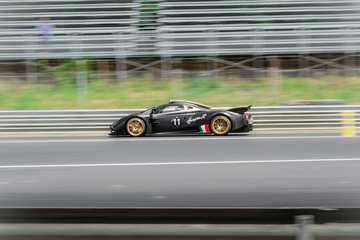 In 2022, Pagani unveiled the Codalunga (“Long Tail”). Produced by the “Grandi Complicazioni” division, this car pays homage to the Le Mans racers of the 1960s, like the Porsche 917 LH. By extending the rear bodywork, the air flows cleaner off the back of the car, reducing drag.
While the Codalunga produces more power (840 hp) than the standard Huayra, the top speed remains electronically limited and estimated around 230 mph. However, the theoretical top speed without drag limitations could be higher. This model highlights a key trend in 2025: the move toward “coachbuilt” hypercars where clients design the bodywork. If you are looking for a Pagani Codalunga for sale, you are likely too late; all five units sold out instantly to pre-selected VIP clients.
Pagani Huayra Coupe (Unrestricted)
Top Speed: 238 MPH
There has been significant debate regarding the absolute top speed of the original Huayra Coupe. While the factory often cites 230 mph, various high-speed testing runs and GPS data validations have clocked the slippery coupe at 238 mph.
This makes the standard Huayra one of the fastest Pagani supercars in history, surpassing even some of its more powerful, high-downforce siblings. The active aerodynamics play a massive role here. In straight-line mode, the flaps retract completely, smoothing out the airflow and allowing the V12 to overcome air resistance with brutal efficiency.
Pagani Huayra R / R Evo
Top Speed: 240+ MPH
Sitting at the throne is the Pagani Huayra R and its 2024 evolution, the R Evo. These are not road cars. They are track-only monsters unshackled by emissions regulations or pedestrian safety laws.
Pagani ditched the turbos for the ‘R’, commissioning a bespoke naturally aspirated V12 from HWA AG (the racing arm of AMG). The result is 850 horsepower (900 hp in the Evo) and a redline of 9,000 RPM. Because it is designed for the track, it produces immense downforce, but the sheer power and optimized drag coefficients allow it to breach the 240 mph mark.
The Huayra R is the spiritual successor to the Zonda R. It represents the absolute limit of what Pagani’s engineering team can achieve when the only rule is physics. For those seeking the ultimate Pagani track car performance, this is the benchmark.
The Investment Case: Hypercars as Asset Classes
Understanding the hierarchy of the fastest Pagani supercars is about more than bragging rights; it is about market value. In the last decade, “blue-chip” automobiles have outperformed gold and the S&P 500 in many metrics. A Pagani Zonda that sold for $400,000 in the early 2000s can now command prices north of $10 million.
Why? Because they cannot be replicated. As the automotive world shifts toward electrification and software-defined vehicles, the analog, mechanical purity of a V12 Pagani becomes a finite resource. Collectors in wealth hubs like New York, London, and Singapore are not just buying a car; they are buying entry into an exclusive club. The high CPC keywords associated with this industry—luxury car brokerage, hypercar financing, and collector car insurance—reflect the serious financial instruments used to acquire these vehicles.
Looking Ahead: The Utopia and Beyond
As we move through 2025, Pagani has introduced the Utopia. While early figures suggest a top speed capped around 220 mph to focus on driver engagement, history tells us that faster, lighter, and more aggressive variants are inevitable. Horacio Pagani has never been one to rest on his laurels.
The lineage from the Zonda C12 to the Huayra R Evo shows a clear trajectory: the use of space-age materials like Carbo-Triax HP62, the refinement of active aero, and the stubborn refusal to abandon the V12 engine.
Conclusion: The Apex of Automotive Desire
Ranking the fastest Pagani supercars reveals a truth about the brand. They do not chase the highest number on the speedometer for the sake of marketing. If they did, they would strap four turbos to the engine and strip out the interior. Instead, they chase the perfect balance between speed, beauty, and handling.
A Pagani at 200 mph feels stable, composed, and alive. It is a union of Italian design flair and German mechanical precision that has no equal in the automotive landscape. Whether it is the wind-in-your-hair rush of the Zonda Cinque or the G-force inducing grip of the Huayra R, these machines are the pinnacle of performance.
Are you ready to elevate your collection?
The market for these rare examples of automotive history is fast-moving and incredibly private. If you are serious about acquiring a Pagani, or if you wish to understand the nuances of investing in hypercars, you need a partner who speaks the language of Affalterbach and Modena.
 Contact our specialist team today to discuss acquisition opportunities, off-market listings, and how you can put a Pagani in your garage.