
10 Production Cars Born from the Race Track: When Engineering Meets the Asphalt
The raw, untamed heart of motorsport beats within the engines of certain road-going vehicles, a lineage of innovation forged in the crucible of competition. These aren’t mere replicas; they are the distilled essence of racing prowess, vehicles that allow ordinary drivers to experience the thrill of the race track on everyday roads. But why do automakers invest heavily in motorsport only to translate that technology to the consumer market? This exhaustive exploration delves into the symbiotic relationship between racing and production cars, tracing the path of competition-derived power plants to the streets of America.
Motorsport serves as the ultimate proving ground for automotive engineering. It pushes the boundaries of speed, endurance, and efficiency under extreme conditions where failure carries high stakes. The lessons learned on the track, the parts tested under relentless stress, and the technologies developed to shave milliseconds off lap times eventually make their way into the vehicles that fill our dealerships. From advanced aerodynamics and lightweight materials to cutting-edge hybrid systems and transmission technology, the advancements driven by racing fundamentally shape the way we drive. This continuous cycle of innovation is the lifeblood of the automotive industry.
Consider the evolution of braking systems and paddle shifters. These technologies were once the exclusive domain of race cars, offering drivers enhanced control and performance. Today, they are standard features in many mainstream production vehicles, a direct trickle-down effect from the track. However, the benefits of motorsport extend beyond technological transfer. Success in professional racing enhances a manufacturer’s brand image, creating an aura of performance and desirability around their consumer products. While most consumers will never pilot a Formula 1 machine or a Le Mans prototype, they can still feel connected to the action, particularly when a race-bred engine resides under the hood of their daily driver. This connection has never been more relevant as automakers re-engage in professional racing, a strategy often described as “Win on Sunday, Sell on Monday.”
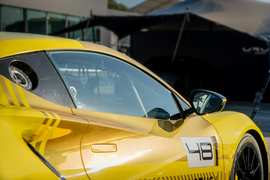
The resurgence of Original Equipment Manufacturer (OEM) entries in motorsport has revitalized the industry, creating a direct pathway from the track to the consumer. This renewed focus on racing has significant implications for the types of vehicles available to consumers, pushing the boundaries of performance and technology. The development of production cars with motorsport DNA is not just a historical curiosity; it is a dynamic process that continues to define the automotive landscape today.
The Evolution of Race Technology in Production Cars
The symbiotic relationship between motorsport and road-going vehicles is long-standing, and the flow of technological innovation has always moved in both directions. While engineering advancements forged in racing have undeniably elevated the capabilities of production cars, the insights gained from designing cars for everyday use have also influenced motorsport.
Early racing cars were often stripped-down versions of production vehicles, but as the sport evolved, automakers began to engineer cars specifically for competition, with technology that eventually benefited the street. The development of the modern automobile owes a significant debt to the demands of racing. The need for speed, durability, and efficiency pushed engineers to develop lightweight materials, improved aerodynamics, and powerful engines that would eventually become standard in passenger vehicles.
In recent years, the lines between racing and production have blurred even further. High-performance production cars often share significant architectural and technological similarities with the race cars that inspired them. This trend has been driven by consumer demand for vehicles that offer a taste of motorsport performance, as well as by the need for manufacturers to differentiate their products in a competitive market.
Technological Integration from Track to Street
The integration of motorsport technology into production cars has accelerated in recent years, driven by advances in materials science, engine design, and electronics. The development of lightweight composite materials, for example, has allowed automakers to reduce vehicle weight while improving performance and fuel efficiency. Similarly, advances in engine technology have enabled manufacturers to develop powerful, efficient engines that can be used in a variety of applications.
The development of advanced electronic systems has also played a significant role in this trend. Advanced traction control systems, active aerodynamics, and adaptive suspension systems are just a few examples of technologies that have been developed for racing and have found their way into production cars. These technologies not only improve performance but also enhance safety and driver control.
The “Win on Sunday, Sell on Monday” Strategy
The “Win on Sunday, Sell on Monday” strategy has been a cornerstone of automotive marketing for decades, but its relevance has never been greater than it is today. In a world where consumers are increasingly discerning, manufacturers are relying on motorsport success to differentiate their products and build brand loyalty.
This strategy has become particularly important in the performance segment of the automotive market, where consumers are looking for vehicles that offer a taste of motorsport performance. By participating in racing and achieving success on the track, manufacturers can build brand equity and create a perception of performance that translates to increased sales.
High-Performance Production Cars with Motorsport DNA
As the lines between racing and production cars blur, a new generation of vehicles has emerged that offer a taste of motorsport performance to ordinary drivers. These vehicles are the direct result of the integration of racing technology into production cars, and they represent the pinnacle of automotive engineering.

From the legendary Ferrari F50 to the modern Ford GT, these vehicles share a common heritage of motorsport innovation. They are the result of decades of engineering advancements, driven by the pursuit of speed, performance, and efficiency.
Production Cars with Motorsport Heritage
Alfa Romeo Montreal
The Alfa Romeo Montreal is a classic example of a production car with motorsport heritage. This iconic sports car featured a 2.6-liter V8 engine originally derived from Alfa Romeo’s Tipo 33 sports prototype, a competitive endurance racer that competed in events such as the Targa Florio and the 24 Hours of Daytona. Though detuned for road use, the engine in the Montreal retained much of its motorsport character, revving up to 7,000 RPM and producing 200 horsepower. The roar of its V8, combined with its sharp styling, made the Montreal one of the coolest and most underrated cars to ever carry Alfa Romeo’s badge.
While the Montreal was not a race car itself, its engine was forged in the fires of competition, providing a direct connection to Alfa Romeo’s motorsport legacy. The car was a significant achievement for the Italian marque, and it remains a highly sought-after collector’s item today. This connection to racing success undoubtedly boosted the Montreal’s desirability among consumers, who recognized the car’s association with high performance and engineering prowess.
BMW M1, M3 (E30), M5 (E28), M6 (E24)
BMW’s racing pedigree is evident in several of its iconic models, most notably the BMW M division. The BMW M1, in particular, was powered by a 3.5-liter inline-six M88 engine derived from the brand’s racing programs, specifically used in BMW’s M1 ProCar series. Later, the same engine would power the E24 M6 and E28 M5. Meanwhile, the E30 M3’s four-cylinder S14 engine was also based on the M88 and M12 turbocharged F1 engines. It took inspiration from BMW’s touring car racing, sharing parts and engineering with the cars that dominated in DTM racing.
BMW’s commitment to motorsport has been a defining characteristic of its brand identity. The development of the M division was a direct result of the automaker’s desire to compete in professional racing, and the M cars have been a consistent success on the track. This success has translated to the production line, where the M cars are highly sought after by consumers who want a taste of BMW’s racing heritage. The “Win on Sunday, Sell on Monday” strategy is alive and well at BMW, as the automaker continues to leverage its racing success to drive sales.
Chevrolet Camaro ZL1
The 1969 Chevrolet Camaro ZL1 featured a 427 cubic-inch (7.0-liter) V8 originally designed for Can-Am racing. With an all-aluminum construction, this engine was light for its size and produced a staggering amount of power—it made 500 hp but was detuned to 430 hp for the road-going version. The ZL1 package turned the Camaro into a street-legal drag strip monster, and its engine lived on in several race cars in the SCCA Trans-Am series. With only 69 examples ever built, the Camaro ZL1 is an incredibly rare and sought-after model today.
The ZL1 package was a direct result of Chevrolet’s efforts to compete in professional racing. The automaker developed the 427 cubic-inch V8 for Can-Am racing, and it eventually found its way into the Camaro ZL1 package. The ZL1 was a dominant force on the track, and it quickly became one of the most iconic muscle cars of its era. Chevrolet’s investment in motorsport paid off, as the ZL1 has become one of the most sought-after collector’s cars in the world.
Ferrari Dino 206 GT

The Ferrari Dino 206 GT featured a 2.0-liter V6 engine that was originally developed for Ferrari’s Formula 2 cars in the 1960s. Though detuned for road use, the engine maintained its high-revving nature, giving the Dino a racing spirit that made it a joy to drive on twisty roads. It produced 180 hp, which was plenty for a car that weighed just over 2,000 pounds. The Dino was one of the few Ferraris that didn’t carry the Ferrari badge and marked the Italian marque’s first foray into mid-engine V6 sports cars, setting a precedent for future models