



The Electrifying Evolution: Is the Ferrari 296 GTB Still the Benchmark for Hybrid Supercars in 2025?
Ten years in the supercar arena, and I’ve witnessed a seismic shift. The raw, analogue symphony of natura
 lly aspirated engines has gracefully, and sometimes jarringly, transitioned into the complex, potent realm of electrification. Amongst this evolution, the Ferrari 296 GTB 2025 stands as a pivotal moment, a car that didn’t just embrace hybridization but redefined it for a segment still grappling with its full potential. While the whispers of rivals like the incoming Lamborghini Temerario grow louder, promising even more astronomical power figures, it’s crucial to revisit the car that has set such a formidable precedent.
The arrival of the Ferrari 296 GTB in 2022 marked an unprecedented departure from Maranello’s storied lineage. The venerable, multi-award-winning twin-turbo V8 was pensioned off, replaced by an entirely new twin-turbo V6, crucially augmented by an electric motor. This bold move positioned the Ferrari 296 GTB at the vanguard of a higher-tier supercar segment, one that, by 2025, is still navigating the intricacies of widespread hybrid adoption.
In its initial phase, the Ferrari 296 GTB’s most direct contemporary was the Lamborghini Huracán, a V10 symphony of naturally aspirated allure. While outgunned in sheer horsepower, the Huracán offered an intoxicating auditory experience and a visceral connection that defined an era. Then there was the McLaren 720S, a twin-turbo V8 behemoth championing power-to-weight supremacy. Today, while the McLaren 750S represents an evolution of that philosophy, the purported 903bhp, 10,000rpm hybrid Temerario from Lamborghini is unequivocally a direct riposte to Maranello’s 819bhp electrified Berlinetta. The Ferrari 296 GTB unleashed serious firepower, and its impact continues to resonate.
The sheer potency of the Ferrari 296 GTB is undeniable. Its all-new, 120-degree, twin-turbo V6, working in concert with an electric motor driving only the rear wheels (a departure from the SF90’s all-wheel-drive setup), delivered a headline 819bhp. This combination didn’t just push boundaries; it fundamentally altered the supercar paradigm. It’s easy to become fixated on these stratospheric power figures, to ponder the inevitable escalation and, perhaps more pragmatically, to question where such velocity can be responsibly unleashed. But that’s a discussion for another time; today, we’re focusing on the machine itself.
The Ferrari 296 GTB holds significant historical weight: it’s the first V6-powered Ferrari road car (barring the Dino, which never wore the Prancing Horse emblem in its time), the first to feature a ‘hot-vee’ turbocharger configuration, and a plug-in hybrid with an estimated 15-mile all-electric range. This compact V6 is nestled low within a new aluminum chassis, featuring a wheelbase 50mm shorter than its V8 predecessors, with occupants positioned slightly further forward. The electric motor contributes a substantial 165bhp and 232lb ft, while the V6 alone thunders out a remarkable 654bhp and 546lb ft. Ferrari, prudently, refrains from quoting a combined peak torque figure, likely due to the complex interplay between the internal combustion engine and electric motor. However, it’s safe to assume the combined output is nothing short of prodigious. Crucially, the V6 unit itself weighs 30kg less than a comparable Ferrari V8, mated to an eight-speed dual-clutch transmission. The battery pack, a long, slim structure, resides discreetly behind the seats.
As expected from a Ferrari, the Ferrari 296 GTB is replete with sophisticated electronic chassis systems, spearheaded by the six-axis 6w-CDS (six-way Chassis Dynamic Sensor). This advanced system measures acceleration and rotational speed across the X, Y, and Z planes, supplanting traditional yaw sensors. In conjunction with a sensor on the steering rack, it provides an unparalleled understanding of driver input and real-time grip levels at the tire contact patch. This data feeds into systems like Side Slip Control and the active E-Diff, optimizing cornering speeds while ensuring unwavering stability. A notable innovation is ABS-evo, active in RACE mode and above. Leveraging the 296 GTB’s brake-by-wire system, it not only shortens braking distances but also enhances performance during trail braking into corners, a testament to its high-performance supercar handling.
For the first time, Ferrari has deployed its active aerodynamics not for drag reduction, but for augmenting downforce. The manufacturer quotes an impressive 360kg of downforce at 155mph, with the deployable rear wing contributing up to 100kg of this figure. The thermal management of the Ferrari 296 GTB is equally intricate. Two radiators in the front manage engine and gearbox cooling, supplemented by two condensers for the battery. Hot air is expelled beneath the car, preventing interference with airflow directed to the intercoolers flanking the bodywork. Small apertures below the headlamps channel air to the brakes, while a roofline-integrated wing creates a ‘virtual’ rear screen, guiding air efficiently to the rear of the vehicle. The majority of the car’s downforce is generated from beneath, with meticulous attention paid to airflow management, the rear diffuser, and the underbody’s ground clearance to maximize the effectiveness of these surfaces.
Our initial encounters with the Ferrari 296 GTB were with examples equipped with the optional Assetto Fiorano package. This performance-oriented upgrade replaces the standard dampers with Multimatic units derived from GT racing, and incorporates additional carbon fiber aerodynamic elements on the nose, boosting front downforce by 20kg. Further weight savings are achieved through increased carbon fiber usage in the cabin (door panels) and exterior, contributing to a 12kg reduction. Opting for the Lexan rear engine cover shaves off an additional 3kg. For the ultimate track-focused setup, the Assetto Fiorano package can be specified with Michelin Pilot Sport Cup 2 R tires, replacing the standard Pilot Sport 4S. These track-ready models can also be adorned with an exterior graphics package, a nod to the iconic 250LM of the 1960s.
Having spent considerable time with the Ferrari 296 GTB, its aesthetic is undeniably captivating. It possesses a unique, almost sculptural quality, reminiscent of the 1960s 250LM, even without the more divisive graphic options. This design language is a far cry from the often-polarizing aesthetics of some contemporaries, offering a timeless elegance that appeals to discerning enthusiasts.
Getting underway in the Ferrari 296 GTB is a seamless affair. A double press on the lower section of the steering wheel boss and engagement of first gear initiates movement. The car defaults to Hybrid mode, utilizing electric power for initial acceleration. Unless aggressively provoked, it will continue on electric power alone, provided the battery retains sufficient charge. This silent departure from urban environments is an unexpected delight. The damping sophistication ensures a surprisingly comfortable ride, even for extended journeys, and the ‘frunk’ offers a reasonably practical storage solution, a welcome contrast to the SF90’s more constrained space. But, naturally, the real question on everyone’s mind, including mine, is the experience when both the V6 and electric motor are unleashed.
The immediate surge of acceleration when planting the throttle from low revs in a high gear is astonishing. There’s an absence of lag, an instantaneous response that makes you momentarily question the need for gear selection. However, with eight gears to exploit and an engine that eagerly revs to 8500rpm, the full experience of the Ferrari 296 GTB is nothing short of sensational. The acceleration figures – a blistering 0-62mph in 2.9 seconds and a top speed of 205mph – translate into a sensation of relentless, almost disorienting, forward momentum. It’s a thrill bordering on the intense, yet paradoxically addictive. And the soundtrack? A harmonizing blend of turbo induction whines and the tuneful rasp of the V6, creating an aural masterpiece. This is supercar acceleration redefined.
lly aspirated engines has gracefully, and sometimes jarringly, transitioned into the complex, potent realm of electrification. Amongst this evolution, the Ferrari 296 GTB 2025 stands as a pivotal moment, a car that didn’t just embrace hybridization but redefined it for a segment still grappling with its full potential. While the whispers of rivals like the incoming Lamborghini Temerario grow louder, promising even more astronomical power figures, it’s crucial to revisit the car that has set such a formidable precedent.
The arrival of the Ferrari 296 GTB in 2022 marked an unprecedented departure from Maranello’s storied lineage. The venerable, multi-award-winning twin-turbo V8 was pensioned off, replaced by an entirely new twin-turbo V6, crucially augmented by an electric motor. This bold move positioned the Ferrari 296 GTB at the vanguard of a higher-tier supercar segment, one that, by 2025, is still navigating the intricacies of widespread hybrid adoption.
In its initial phase, the Ferrari 296 GTB’s most direct contemporary was the Lamborghini Huracán, a V10 symphony of naturally aspirated allure. While outgunned in sheer horsepower, the Huracán offered an intoxicating auditory experience and a visceral connection that defined an era. Then there was the McLaren 720S, a twin-turbo V8 behemoth championing power-to-weight supremacy. Today, while the McLaren 750S represents an evolution of that philosophy, the purported 903bhp, 10,000rpm hybrid Temerario from Lamborghini is unequivocally a direct riposte to Maranello’s 819bhp electrified Berlinetta. The Ferrari 296 GTB unleashed serious firepower, and its impact continues to resonate.
The sheer potency of the Ferrari 296 GTB is undeniable. Its all-new, 120-degree, twin-turbo V6, working in concert with an electric motor driving only the rear wheels (a departure from the SF90’s all-wheel-drive setup), delivered a headline 819bhp. This combination didn’t just push boundaries; it fundamentally altered the supercar paradigm. It’s easy to become fixated on these stratospheric power figures, to ponder the inevitable escalation and, perhaps more pragmatically, to question where such velocity can be responsibly unleashed. But that’s a discussion for another time; today, we’re focusing on the machine itself.
The Ferrari 296 GTB holds significant historical weight: it’s the first V6-powered Ferrari road car (barring the Dino, which never wore the Prancing Horse emblem in its time), the first to feature a ‘hot-vee’ turbocharger configuration, and a plug-in hybrid with an estimated 15-mile all-electric range. This compact V6 is nestled low within a new aluminum chassis, featuring a wheelbase 50mm shorter than its V8 predecessors, with occupants positioned slightly further forward. The electric motor contributes a substantial 165bhp and 232lb ft, while the V6 alone thunders out a remarkable 654bhp and 546lb ft. Ferrari, prudently, refrains from quoting a combined peak torque figure, likely due to the complex interplay between the internal combustion engine and electric motor. However, it’s safe to assume the combined output is nothing short of prodigious. Crucially, the V6 unit itself weighs 30kg less than a comparable Ferrari V8, mated to an eight-speed dual-clutch transmission. The battery pack, a long, slim structure, resides discreetly behind the seats.
As expected from a Ferrari, the Ferrari 296 GTB is replete with sophisticated electronic chassis systems, spearheaded by the six-axis 6w-CDS (six-way Chassis Dynamic Sensor). This advanced system measures acceleration and rotational speed across the X, Y, and Z planes, supplanting traditional yaw sensors. In conjunction with a sensor on the steering rack, it provides an unparalleled understanding of driver input and real-time grip levels at the tire contact patch. This data feeds into systems like Side Slip Control and the active E-Diff, optimizing cornering speeds while ensuring unwavering stability. A notable innovation is ABS-evo, active in RACE mode and above. Leveraging the 296 GTB’s brake-by-wire system, it not only shortens braking distances but also enhances performance during trail braking into corners, a testament to its high-performance supercar handling.
For the first time, Ferrari has deployed its active aerodynamics not for drag reduction, but for augmenting downforce. The manufacturer quotes an impressive 360kg of downforce at 155mph, with the deployable rear wing contributing up to 100kg of this figure. The thermal management of the Ferrari 296 GTB is equally intricate. Two radiators in the front manage engine and gearbox cooling, supplemented by two condensers for the battery. Hot air is expelled beneath the car, preventing interference with airflow directed to the intercoolers flanking the bodywork. Small apertures below the headlamps channel air to the brakes, while a roofline-integrated wing creates a ‘virtual’ rear screen, guiding air efficiently to the rear of the vehicle. The majority of the car’s downforce is generated from beneath, with meticulous attention paid to airflow management, the rear diffuser, and the underbody’s ground clearance to maximize the effectiveness of these surfaces.
Our initial encounters with the Ferrari 296 GTB were with examples equipped with the optional Assetto Fiorano package. This performance-oriented upgrade replaces the standard dampers with Multimatic units derived from GT racing, and incorporates additional carbon fiber aerodynamic elements on the nose, boosting front downforce by 20kg. Further weight savings are achieved through increased carbon fiber usage in the cabin (door panels) and exterior, contributing to a 12kg reduction. Opting for the Lexan rear engine cover shaves off an additional 3kg. For the ultimate track-focused setup, the Assetto Fiorano package can be specified with Michelin Pilot Sport Cup 2 R tires, replacing the standard Pilot Sport 4S. These track-ready models can also be adorned with an exterior graphics package, a nod to the iconic 250LM of the 1960s.
Having spent considerable time with the Ferrari 296 GTB, its aesthetic is undeniably captivating. It possesses a unique, almost sculptural quality, reminiscent of the 1960s 250LM, even without the more divisive graphic options. This design language is a far cry from the often-polarizing aesthetics of some contemporaries, offering a timeless elegance that appeals to discerning enthusiasts.
Getting underway in the Ferrari 296 GTB is a seamless affair. A double press on the lower section of the steering wheel boss and engagement of first gear initiates movement. The car defaults to Hybrid mode, utilizing electric power for initial acceleration. Unless aggressively provoked, it will continue on electric power alone, provided the battery retains sufficient charge. This silent departure from urban environments is an unexpected delight. The damping sophistication ensures a surprisingly comfortable ride, even for extended journeys, and the ‘frunk’ offers a reasonably practical storage solution, a welcome contrast to the SF90’s more constrained space. But, naturally, the real question on everyone’s mind, including mine, is the experience when both the V6 and electric motor are unleashed.
The immediate surge of acceleration when planting the throttle from low revs in a high gear is astonishing. There’s an absence of lag, an instantaneous response that makes you momentarily question the need for gear selection. However, with eight gears to exploit and an engine that eagerly revs to 8500rpm, the full experience of the Ferrari 296 GTB is nothing short of sensational. The acceleration figures – a blistering 0-62mph in 2.9 seconds and a top speed of 205mph – translate into a sensation of relentless, almost disorienting, forward momentum. It’s a thrill bordering on the intense, yet paradoxically addictive. And the soundtrack? A harmonizing blend of turbo induction whines and the tuneful rasp of the V6, creating an aural masterpiece. This is supercar acceleration redefined.
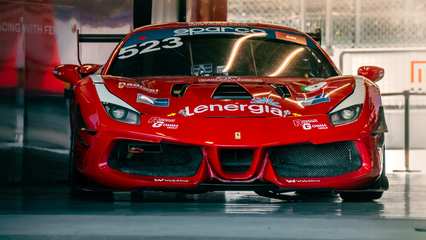 The chassis responsiveness of the Ferrari 296 GTB is truly remarkable. Ferrari’s claim of making this car ‘fun to drive’ is not an exaggeration; it feels exceptionally agile without ever becoming nervous. The steering is typically Ferrari – light and rapid – yet it also conveys a surprising amount of road feel and detail. Grip levels are, as one would expect, immense, but what truly elevates the driving experience is the car’s adjustability on the throttle. Even with the electronic nannies engaged, there’s a tangible sense of connection, a willingness for the car to dance with your inputs, eliciting pure joy. It feels considerably lighter than its dry weight of 1470kg suggests, exhibiting a fluidity and nimbleness that encourages precise, small inputs. The CT Off mode allows for daring exploits with the implicit reassurance of advanced electronic safeguards. Even with all systems deactivated, the inherent balance of the Ferrari 296 GTB allows for controlled oversteer, a feat one might not expect from a car producing 819bhp.
On track, the Ferrari 296 GTB has the uncanny ability to make even the longest straights feel manageable. It transforms into a razor-sharp instrument, capable of breaking traction at numerous points around the circuit, yet it remains exquisitely sensitive to braking and steering inputs. Precision is rewarded tenfold, leading to a dramatic reduction in corner entry times. Instead of easing into turns, the Ferrari 296 GTB, particularly with the Multimatic dampers and the enhanced roll support of the Assetto Fiorano setup, takes an immediate set. The hyper-quick steering complements this perfectly, making it an absolute joy to drive lap after lap, a testament to its elite supercar dynamics.
The interior architecture of the Ferrari 296 GTB will feel familiar to those who have experienced the SF90. The fully digital interface and its accompanying haptic switchgear, liberally scattered across the steering wheel and traditional Ferrari pods, present a significant learning curve. While the sheer volume of information to process is substantial, the primary frustration lies in the occasional need for a second press for inputs to register, or the ambiguity of whether a command has been acknowledged. Despite these quirks, the cabin exudes an undeniable sense of occasion, a truly special place to inhabit.
The Ferrari 296 GTB was a significant contender in the evo Car of the Year 2022 awards, narrowly missing out on victory but earning widespread acclaim. Road testers were split between the Ferrari and the McLaren Artura, a testament to the fierce competition and the subjective nature of ultimate preference. Jethro Bovingdon lauded its “spectacular” nature, praising its beauty, blistering speed, exploitable performance, and technical brilliance. He highlighted how its V6 demonstrated a path to downsizing with heightened drama, matching the Artura’s control while offering a more playful and indulgent character. Dickie Meaden declared it the “first genuinely beautiful Ferrari since the F355,” a sentiment echoed by many. He noted the seamless integration of the hybrid system, which altered the driving experience less than anticipated, likely due to the familiar torque characteristics of Ferrari’s turbocharged V8s. He praised the V6’s character and its always-sweet soundtrack that evolves with throttle input.
While the hybrid integration was widely applauded, a singular incident saw the car stranded after a battery depletion, a potential vulnerability that Ferrari had warned of. This oversight in engineering a fail-safe, especially from a company known for innovative engineering, was noted as a significant flaw. However, this occurred after scoring, and it didn’t detract from the car’s overall brilliance. Ferrari’s signature ultra-quick steering divided opinion, and brake feel wasn’t universally lauded as best-in-class, with the tech interface drawing widespread criticism for its complexity. Nevertheless, the Ferrari 296 GTB proved irresistibly seductive. Vivian summed up the sentiment of many: “I thought I wouldn’t like the Fezza all that much – too complex, rather gratuitous points of difference – but I ended up somewhat bewitched: the spooky way it changes direction; its amazing damping and looney-tunes levels of grip; the linearity of seemingly never-ending power…”
The Ferrari 296 GTS review (a convertible variant) also highlighted that the core essence of the car remained largely intact, even with the roof down. Peter Tomalin’s verdict for evo Car of the Year 2022 concluded that the 296 GTB represented a significant return to form for Ferrari after the SF90 left some feeling cold. He emphasized that the 296’s technical sophistication and hybrid integration felt far more natural and less intrusive. Gallagher agreed, stating that Ferrari had learned immensely from the SF90, distilling those lessons into a series production model that stands as one of its very best.
There’s always an inherent risk when a car is so densely packed with technology that it might become less than the sum of its parts – a pitfall we observed with the SF90, which, despite its dazzling power, felt somewhat detached in its driving characteristics. However, the Ferrari 296 GTB is a different proposition entirely. As evident from its strong showing at the evo Car of the Year 2022 awards, where it secured joint third place alongside the McLaren Artura, it possesses a much more organic feel. Its masterful blend of power and engaging dynamics strikes a perfect chord, effectively redefining what a £250,000-ish supercar can and should be. Rumors of a Versione Speciale variant, promising even greater intensity, are circulating, and the hope is that the standard Ferrari 296 GTB’s inexplicable natural feel will be preserved.
It is precisely this aspect – the nuanced and engaging driving experience – that we hope Lamborghini has prioritized in the development of its hybrid Temerario supercar. Over 900bhp is an obscene amount of power, and if not perfectly balanced by the rest of the vehicle’s dynamics, it can easily overwhelm. If Lamborghini has indeed mastered this integration, as their success with the Revuelto suggests they might have, we are poised for an epic 1700bhp twin-test.
Alternatively, we could expand that to a colossal 2400bhp triple threat by including the McLaren 750S, now somewhat absurdly the ‘minnow’ of this class with “only” 740bhp. However, its relative lightness (1389kg kerb weight) ensures a competitive power-to-weight ratio. The McLaren’s raw character, ergonomic perfection, razor-sharp steering, and deft chassis continue to set it apart from the comparatively more remote feel of the Ferrari.
Ultimately, the Ferrari 296 GTB is more than just a collection of impressive numbers; it’s a statement of intent, a sophisticated symphony of internal combustion and electric power, expertly orchestrated to deliver an unparalleled driving experience. For those seeking the pinnacle of luxury performance vehicles and a glimpse into the future of the supercar, the Ferrari 296 GTB remains an essential benchmark.
The chassis responsiveness of the Ferrari 296 GTB is truly remarkable. Ferrari’s claim of making this car ‘fun to drive’ is not an exaggeration; it feels exceptionally agile without ever becoming nervous. The steering is typically Ferrari – light and rapid – yet it also conveys a surprising amount of road feel and detail. Grip levels are, as one would expect, immense, but what truly elevates the driving experience is the car’s adjustability on the throttle. Even with the electronic nannies engaged, there’s a tangible sense of connection, a willingness for the car to dance with your inputs, eliciting pure joy. It feels considerably lighter than its dry weight of 1470kg suggests, exhibiting a fluidity and nimbleness that encourages precise, small inputs. The CT Off mode allows for daring exploits with the implicit reassurance of advanced electronic safeguards. Even with all systems deactivated, the inherent balance of the Ferrari 296 GTB allows for controlled oversteer, a feat one might not expect from a car producing 819bhp.
On track, the Ferrari 296 GTB has the uncanny ability to make even the longest straights feel manageable. It transforms into a razor-sharp instrument, capable of breaking traction at numerous points around the circuit, yet it remains exquisitely sensitive to braking and steering inputs. Precision is rewarded tenfold, leading to a dramatic reduction in corner entry times. Instead of easing into turns, the Ferrari 296 GTB, particularly with the Multimatic dampers and the enhanced roll support of the Assetto Fiorano setup, takes an immediate set. The hyper-quick steering complements this perfectly, making it an absolute joy to drive lap after lap, a testament to its elite supercar dynamics.
The interior architecture of the Ferrari 296 GTB will feel familiar to those who have experienced the SF90. The fully digital interface and its accompanying haptic switchgear, liberally scattered across the steering wheel and traditional Ferrari pods, present a significant learning curve. While the sheer volume of information to process is substantial, the primary frustration lies in the occasional need for a second press for inputs to register, or the ambiguity of whether a command has been acknowledged. Despite these quirks, the cabin exudes an undeniable sense of occasion, a truly special place to inhabit.
The Ferrari 296 GTB was a significant contender in the evo Car of the Year 2022 awards, narrowly missing out on victory but earning widespread acclaim. Road testers were split between the Ferrari and the McLaren Artura, a testament to the fierce competition and the subjective nature of ultimate preference. Jethro Bovingdon lauded its “spectacular” nature, praising its beauty, blistering speed, exploitable performance, and technical brilliance. He highlighted how its V6 demonstrated a path to downsizing with heightened drama, matching the Artura’s control while offering a more playful and indulgent character. Dickie Meaden declared it the “first genuinely beautiful Ferrari since the F355,” a sentiment echoed by many. He noted the seamless integration of the hybrid system, which altered the driving experience less than anticipated, likely due to the familiar torque characteristics of Ferrari’s turbocharged V8s. He praised the V6’s character and its always-sweet soundtrack that evolves with throttle input.
While the hybrid integration was widely applauded, a singular incident saw the car stranded after a battery depletion, a potential vulnerability that Ferrari had warned of. This oversight in engineering a fail-safe, especially from a company known for innovative engineering, was noted as a significant flaw. However, this occurred after scoring, and it didn’t detract from the car’s overall brilliance. Ferrari’s signature ultra-quick steering divided opinion, and brake feel wasn’t universally lauded as best-in-class, with the tech interface drawing widespread criticism for its complexity. Nevertheless, the Ferrari 296 GTB proved irresistibly seductive. Vivian summed up the sentiment of many: “I thought I wouldn’t like the Fezza all that much – too complex, rather gratuitous points of difference – but I ended up somewhat bewitched: the spooky way it changes direction; its amazing damping and looney-tunes levels of grip; the linearity of seemingly never-ending power…”
The Ferrari 296 GTS review (a convertible variant) also highlighted that the core essence of the car remained largely intact, even with the roof down. Peter Tomalin’s verdict for evo Car of the Year 2022 concluded that the 296 GTB represented a significant return to form for Ferrari after the SF90 left some feeling cold. He emphasized that the 296’s technical sophistication and hybrid integration felt far more natural and less intrusive. Gallagher agreed, stating that Ferrari had learned immensely from the SF90, distilling those lessons into a series production model that stands as one of its very best.
There’s always an inherent risk when a car is so densely packed with technology that it might become less than the sum of its parts – a pitfall we observed with the SF90, which, despite its dazzling power, felt somewhat detached in its driving characteristics. However, the Ferrari 296 GTB is a different proposition entirely. As evident from its strong showing at the evo Car of the Year 2022 awards, where it secured joint third place alongside the McLaren Artura, it possesses a much more organic feel. Its masterful blend of power and engaging dynamics strikes a perfect chord, effectively redefining what a £250,000-ish supercar can and should be. Rumors of a Versione Speciale variant, promising even greater intensity, are circulating, and the hope is that the standard Ferrari 296 GTB’s inexplicable natural feel will be preserved.
It is precisely this aspect – the nuanced and engaging driving experience – that we hope Lamborghini has prioritized in the development of its hybrid Temerario supercar. Over 900bhp is an obscene amount of power, and if not perfectly balanced by the rest of the vehicle’s dynamics, it can easily overwhelm. If Lamborghini has indeed mastered this integration, as their success with the Revuelto suggests they might have, we are poised for an epic 1700bhp twin-test.
Alternatively, we could expand that to a colossal 2400bhp triple threat by including the McLaren 750S, now somewhat absurdly the ‘minnow’ of this class with “only” 740bhp. However, its relative lightness (1389kg kerb weight) ensures a competitive power-to-weight ratio. The McLaren’s raw character, ergonomic perfection, razor-sharp steering, and deft chassis continue to set it apart from the comparatively more remote feel of the Ferrari.
Ultimately, the Ferrari 296 GTB is more than just a collection of impressive numbers; it’s a statement of intent, a sophisticated symphony of internal combustion and electric power, expertly orchestrated to deliver an unparalleled driving experience. For those seeking the pinnacle of luxury performance vehicles and a glimpse into the future of the supercar, the Ferrari 296 GTB remains an essential benchmark.
 Ready to explore the future of automotive excellence? Contact your local Ferrari dealership today to arrange a private viewing and discover the electrifying capabilities of the Ferrari 296 GTB.